October 19, 2026
Overview
My role
- Architect: I designed the whole architecture from the first commit (monorepo, API, iOS app, web, design system, shared contracts) and wrote the guides that describe it
- Team lead: technical leadership of 4 developers (iOS and API, Android, web), with the coding standards, branching rules and release process I put in place
- AI: design and development of Koach, the app's AI agent
- Release: App Store submission, Apple guideline compliance and StoreKit 2 billing
Architecture and decisions
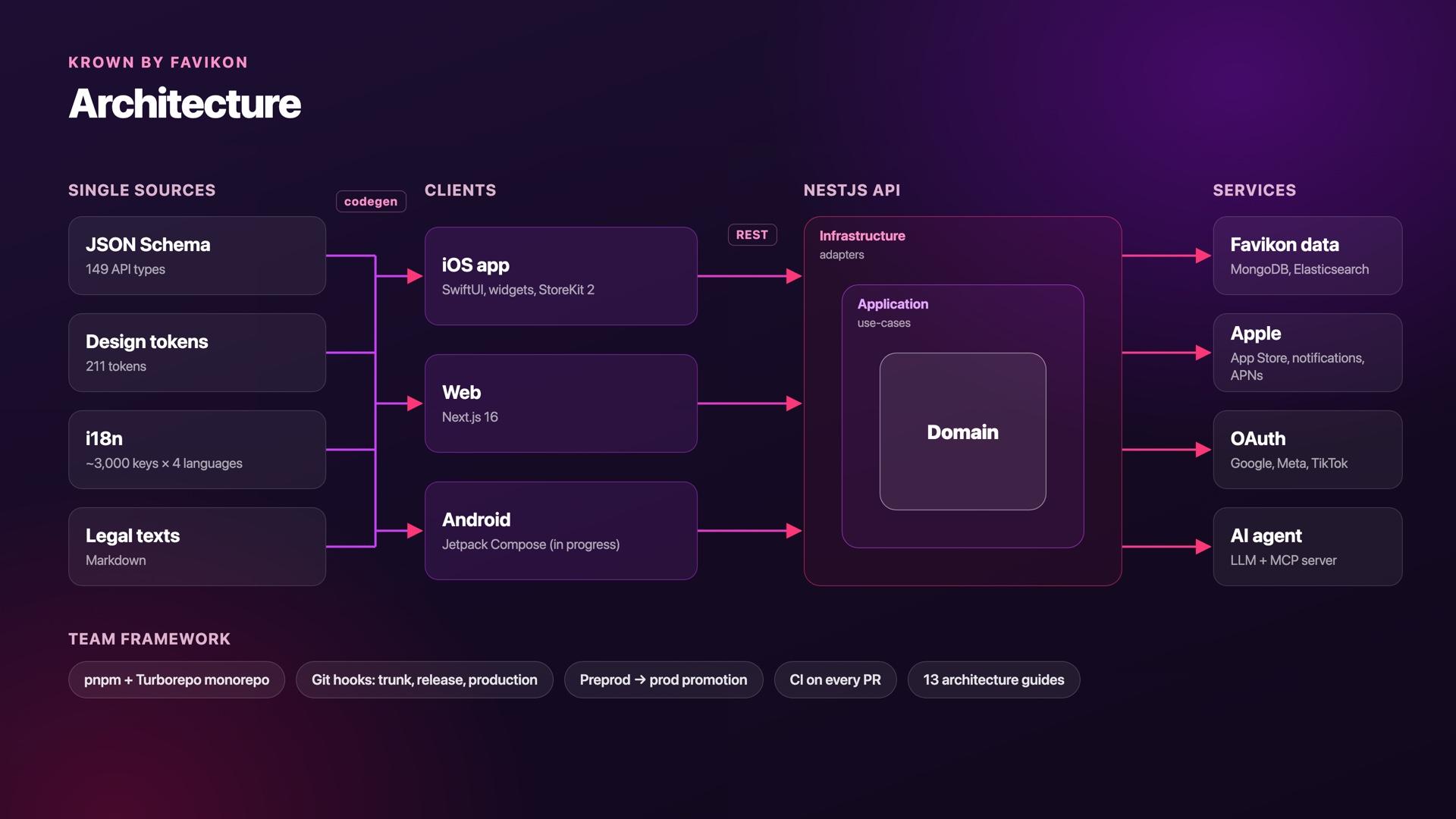
One monorepo for four platforms
krown/
├── apps/
│   ├── ios/            # SwiftUI (iOS 17+), widgets
│   ├── api/            # NestJS 11, hexagonal
│   ├── web/            # Next.js 16
│   └── android/        # Jetpack Compose (in progress)
└── packages/
    ├── types/          # 149 JSON Schemas → TS, Swift, Kotlin
    ├── design-tokens/  # 211 tokens → iOS, web, Android
    ├── ui-ios/         # SwiftUI design system
    ├── ui-web/         # Web design system
    ├── ui-android/     # Compose design system
    ├── i18n/           # ~3,000 keys × 4 languages
    ├── content/        # Legal texts → iOS + web
    └── brand-assets/   # Logos, badges, illustrations
One source of truth for types
A hexagonal API
modules/<module>/
├── domain/          # entities and value objects, no framework
├── application/
│   ├── ports/       # interfaces to the outside world
│   └── use-cases/   # application logic, knows only the ports
├── infrastructure/  # adapters: data, search, payments, LLM
└── presentation/ # REST controllers and DTOs- Dependencies point to the domain. The domain imports neither NestJS, nor the ORM, nor the search engine. Use-cases only know ports, and NestJS only provides their dependency injection.
- Everything external is an adapter: database, search engine, App Store, analytics, notifications and the language model. Switching provider means writing a new adapter, without touching the use-cases.
- Two driving adapters, one logic. The app's REST controllers and the AI agent's MCP server call the same use-cases: the agent reuses the business logic instead of duplicating it.
- Testable without infrastructure. 227 of the 234 use-case test files run on in-memory fakes of the ports (188 fakes, the language model included), with no database and no network.
- Favikon's shared data can only be reached from the infrastructure layer, a rule set from the first commit and documented in the API guide.
The server stays in charge
- Access rights are computed on the server: the app never decides on its own, it shows what the API computes.
- Remote version gating and feature flags: turning a feature on or requiring an update does not need a new build.
- One version per deployable, and an iOS build number that only goes up, so the API always knows which app version it is answering.
- On iOS, a stale-while-revalidate hybrid cache between the repositories and the network keeps the app usable offline.
One design system on three platforms
Team framework
- 13 architecture guides (data flows, design system, git workflow, Apple integrations…), written for the team and for its coding agents
- Rules enforced by tools rather than by review: git hooks on branches (trunk, release, production), Conventional Commits, linting across the three languages
- A release process:
masterdeploys to preprod,productiononly moves through a fast-forward promotion of a validated commit, tagged on every release; the API and the web always ship together - On iOS: one release branch per version, cherry-picked fixes and one tag per build uploaded to Apple
- CI on every pull request to protect the contracts shared across platforms
The product
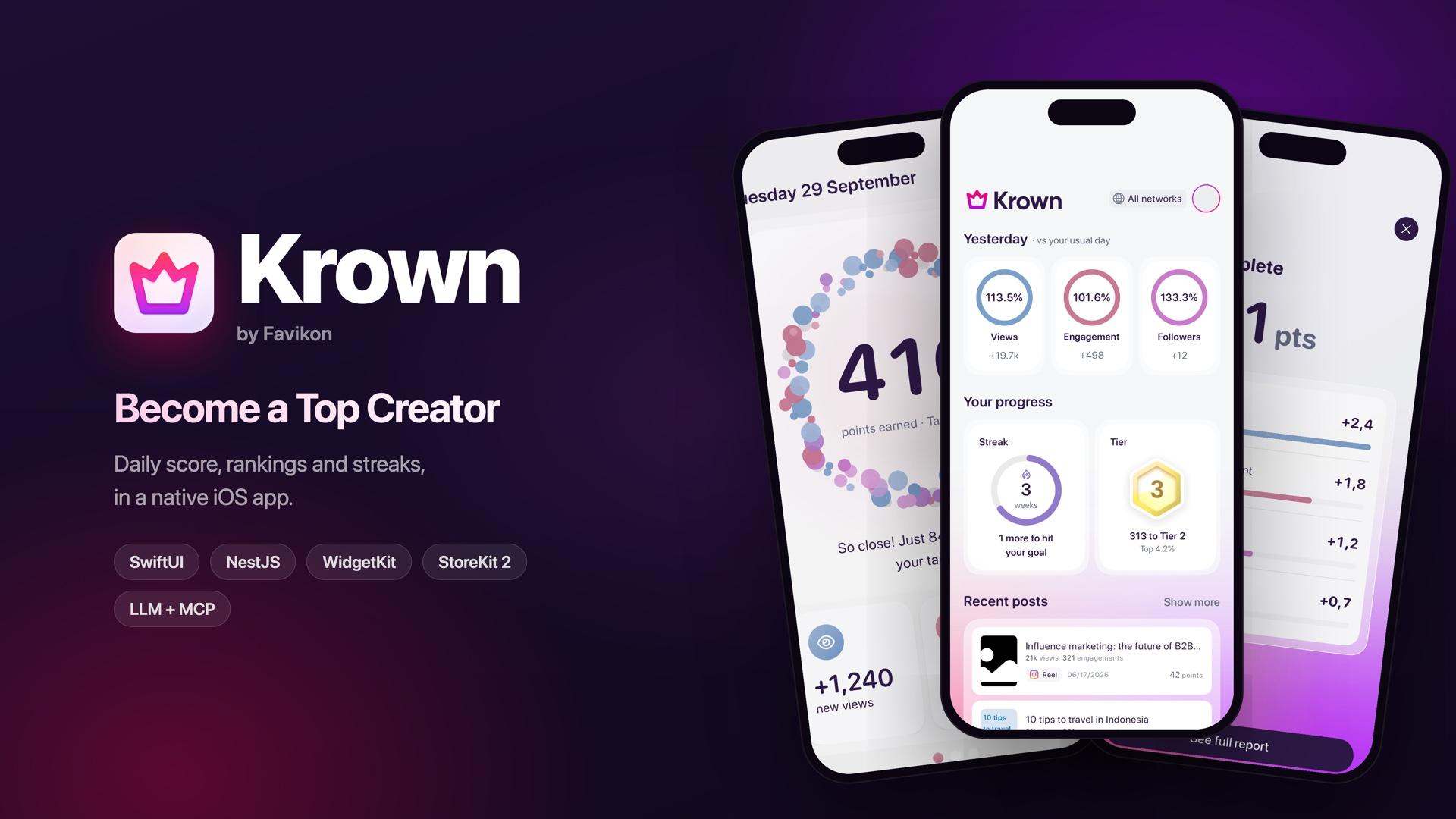
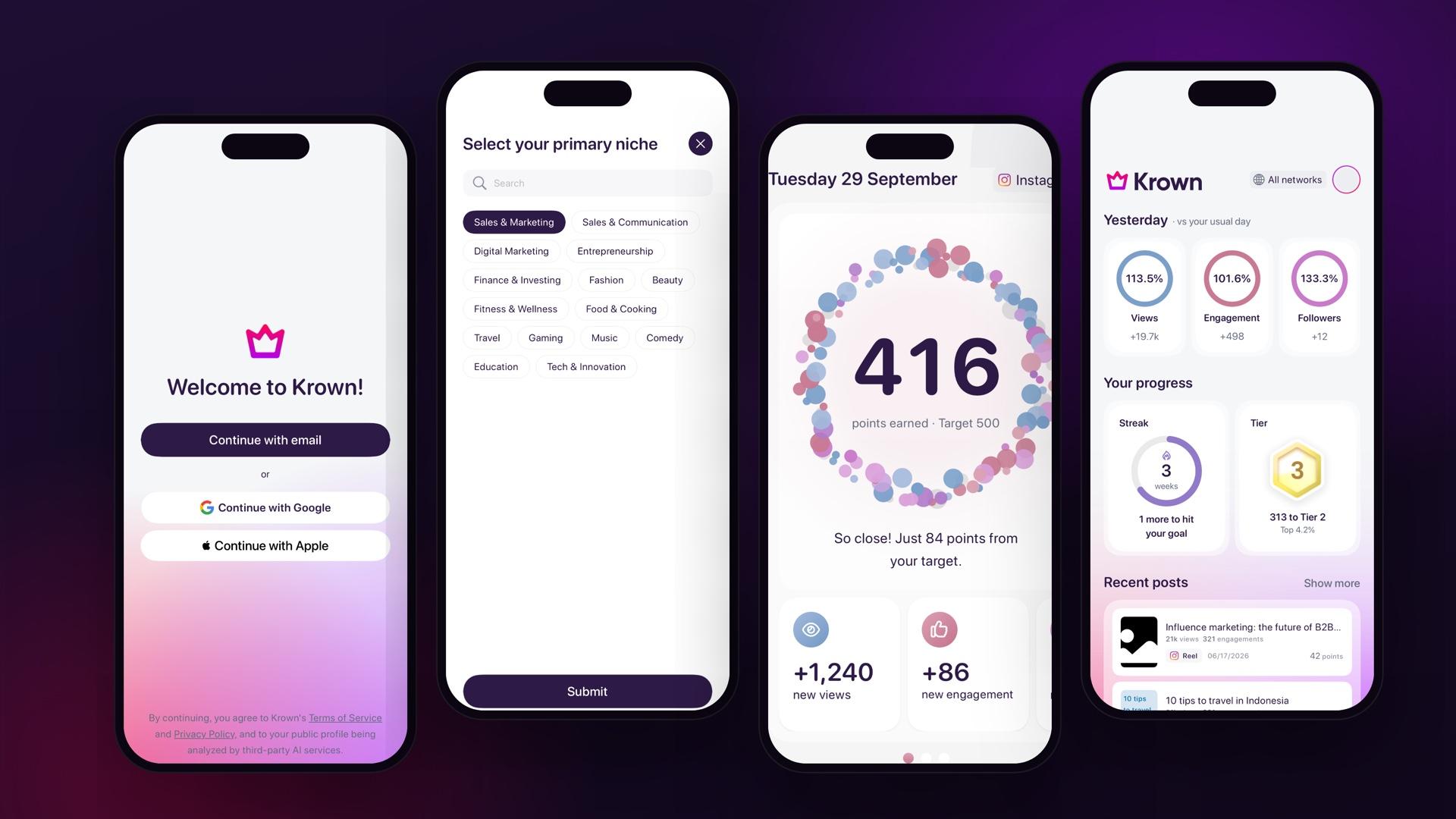
- Daily Authority Score, broken down into Reach, Engagement, Audience and Consistency, with a daily target
- Rankings (global, by niche, by country) and posting streaks from Bronze to Challenger
- Post score, elite medals and "Krowns" for the best post in each arena
- Content DNA and Explore & Compare to see where you stand against other creators
- Widgets, Live Activity and Control Center on the Home Screen and Lock Screen
- Account verification through official OAuth (Instagram, TikTok, YouTube) and a StoreKit 2 subscription
Koach, the AI agent
Tech stack
iOS
- Swift 5.9, SwiftUI, iOS 17+, project generated with XcodeGen
- MVVM with
@Observable, typed navigation (NavigationStack) - WidgetKit, ActivityKit (Live Activities), AppIntents (Control Center), StoreKit 2, Sign in with Apple, RealityKit (3D badges)
Backend
- NestJS 11, Node 20, TypeScript: hexagonal architecture (ports & adapters), 34 modules
- MongoDB (Mongoose), Elasticsearch 8, S3 storage
- App Store Server Library, APNs, Swagger, zod
AI
- LLM agent powered by an MCP server (
@modelcontextprotocol/sdk), embeddings for post search, SSE streaming
Web & Android
- Next.js 16, React 19, Tailwind CSS 4, next-intl
- Kotlin 2, Jetpack Compose, Material 3 (in progress)
Tooling & CI/CD
- Monorepo: pnpm workspaces + Turborepo
- Quality: ESLint, Prettier, SwiftLint, SwiftFormat, ktlint, commitlint, husky
- Tests: Jest on the API, XCTest and snapshot tests on iOS
- Environments: separate preprod and prod
Challenges and learnings
- From an empty repo to App Store approval in five and a half months, on a polyglot product whose contracts are shared across four platforms.
- Growing the team without losing consistency: architecture guides, rules enforced by tools and a CI that protects the contracts made it possible to onboard new developers without drift.
- App Store compliance: I led the compliance work before submission (Sign in with Apple, account deletion, AI consent, privacy manifest, legal texts), split into 16 prioritized work items.
- Solid billing: server-side entitlements, idempotent App Store notifications, sandbox and production verified side by side.
- Third-party reviews: OAuth apps approved by Google (YouTube), Meta (Instagram) and TikTok.
By the numbers
- Five and a half months from the first commit to App Store approval
- 4 platforms in a single monorepo and 34 modules of hexagonal API
- ~10,000 automated tests: ~6,300 on the API, ~3,700 on iOS
- 149 shared schemas, 211 design tokens, ~3,000 translation keys in 4 languages
- 13 architecture guides