October 18, 2026
Overview
Key features
7 live machines in 4 series
- MCH-001 Hexagonal architecture: 3 scenarios, 3 what-ifs, exploded view ("Unplug the adapters")
- MCH-002 JavaScript event loop: code listing, "A D C B" console, blocked stack, endless microtasks
- MCH-003 Redis cache-aside
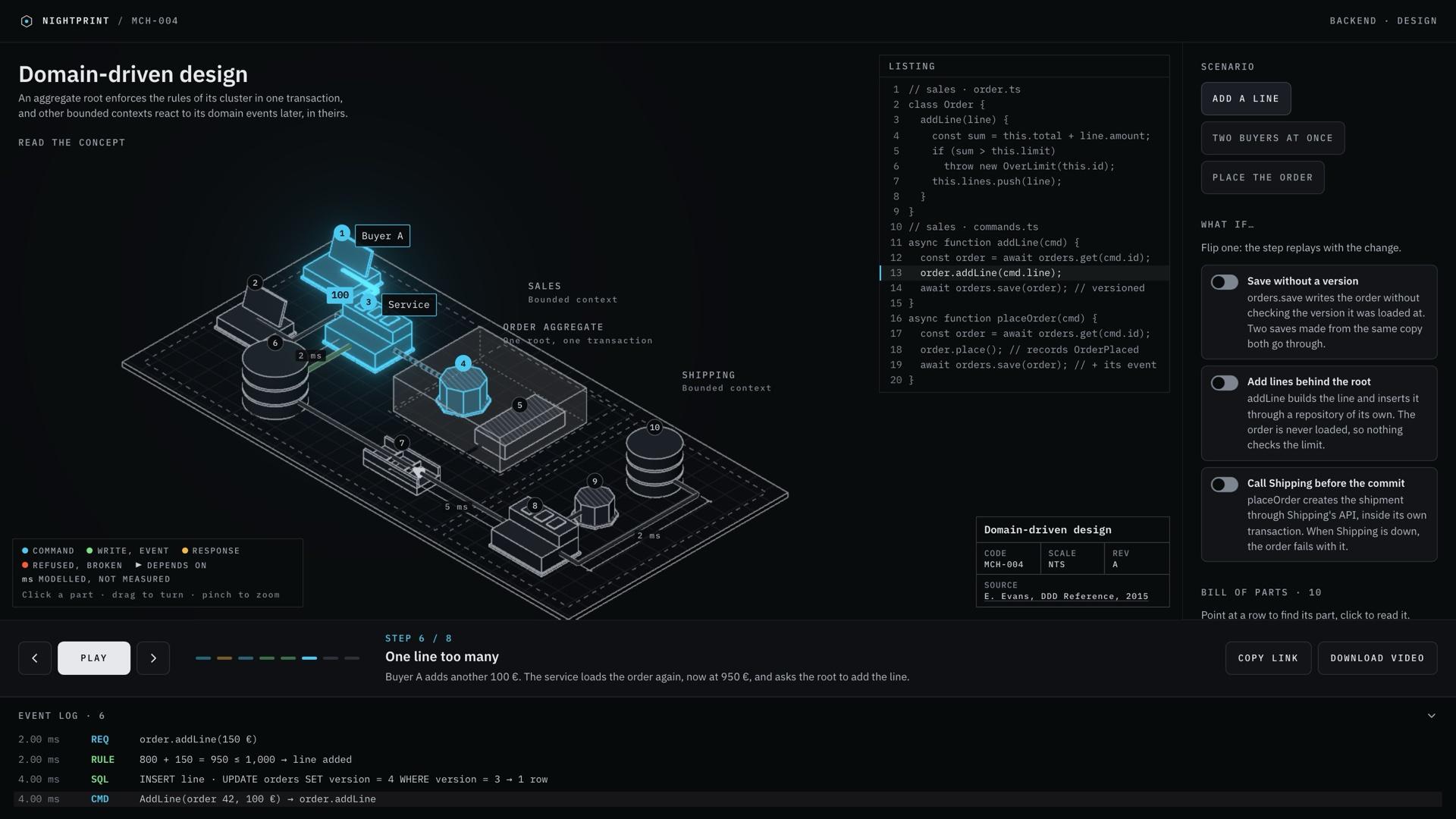
- MCH-004 Domain-driven design: aggregate root, versioning, outbox
- BEN-001 RAG vs CAG vs KAG: a test bench with a scoreboard
- FMD-001 Retry storm: "one click becomes 64 attempts", database load chart, the switches repair the machine
- PRT-001 TLS 1.3 handshake: timing diagram
The machine page
- Guided scenarios (play, step), "What if…" switches, clickable bill of parts, event log
- Short article with sources, glossary and code listing
- Plain-language mode: one line per step, out-of-focus parts dimmed
- Copy link, download video (MP4 generated in the browser)
- Accessibility: keyboard control (← → to step, space to play), reduced motion, AA contrast tested in CI, checked from 320 px to 1440 px
AI importer: "Draw your repository"
/import, a visitor pastes a public JS/TS GitHub repository. About two minutes later it comes back as a machine drawn from its own code, with a shareable link. Claude groups the code into parts and writes the story, but every route between two parts must stand on a real import. The model's reasoning summary is shown live while the machine is drawn.
Architecture
nightprint/
├── apps/
│   ├── web/        # Next.js 16, video export
│   ├── importer/   # API + "draw" CLI
│   └── video/      # Remotion (X / LinkedIn videos)
└── packages/
    ├── engine/     # zod schema, deterministic player
    ├── catalog/    # Machines as pure data
    ├── scene/      # R3F scene, WebGPU rendering
    ├── blueprint/  # Repo survey, automatic layout
    ├── ui/         # Design system (72 components)
    └── tokens/     # Design tokens, contrast tests
The site follows the rule it explains
package.json and by an architecture test that runs on every pnpm check. A wink: PRJ-001 is Nightprint drawn by its own importer, and its what-ifs are "Import the scene in the engine" and "Import engine in the UI kit". I apply the same architecture in production on the Krown API.
A machine is data
defineMachine() resolves all 2ⁿ switch combinations at import time: a broken step fails both the tests and the build. Adding a machine means one file and one line.
Time lives in the engine
player.sample() once per frame, with no per-frame React state. That determinism pays off three times: frame-exact replay, frame-by-frame capture of the live site with Remotion (with Playwright freezing the clock), and an exact MP4 export in the browser (WebCodecs + mediabunny).
Importer pipeline
- Read the public repository at a fixed commit (≤ 3,000 files, JS/TS only)
- Survey it without any LLM: units, imports (TypeScript compiler API), libraries, entry points
- Claude produces a blueprint: parts, zones, scenarios, what-ifs, article, glossary
checkBlueprintanddefineMachinevalidate it; small slips are repaired in place, everything else goes back to the model (3 attempts max)drawMachinelays it out deterministically: zones, parts, right-angle routes
Tech stack
Frontend & 3D
- Framework: Next.js 16 (App Router, Turbopack, static export), React 19, TypeScript 6
- 3D: three.js with
WebGPURenderer(automatic WebGL2 fallback), TSL node materials, selective MRT bloom,LineSegments2fat-line edges - R3F: React Three Fiber 9, without drei or GLSL to stay WebGPU-safe
- UI: Tailwind CSS 4 (default palette removed, tokens only), IBM Plex, atomic design system
- Validation: zod 4
Video
- In the browser: WebCodecs
VideoEncoder(H.264, 1080p, 30 fps) + mediabunny for MP4 muxing - Offline: Remotion 4 + Playwright, frame-by-frame capture of the live site, 16:9 and 9:16 formats
AI (importer)
- Model: Claude Haiku through the Anthropic SDK, streaming, adaptive thinking (summary shown live), prompt caching
- Static analysis: TypeScript compiler API to extract imports
- Server: plain Node
httpbundled with esbuild, in-memory job queue, JSON storage on a Docker volume
Quality & DevOps
- Monorepo: Turborepo + pnpm (9 workspaces), Biome
- Tests: ~270 tests (Vitest +
node:testarchitecture tests) - CI/CD: GitHub Actions. The static site is deployed atomically over SSH (a key restricted to one forced command), then the job checks that the served commit is the right one. The importer ships as a Docker image (GHCR) with a healthcheck and automatic rollback.
- Hosting: personal VPS behind Caddy (Let's Encrypt), hardened container (read-only filesystem,
cap_drop ALL, non-root, 512 MB and 1 CPU)
Challenges and learnings
- WebGPU in production: compiling a new pipeline when a switch flipped caused a 166 ms stall. The fix: mount every possible route up front and fade them in through uniforms.
- DOM labels over the canvas: drei's
<Html>(9 React errors per page under Strict Mode) was replaced by a custom label projector. - Making an LLM trustworthy: deterministic survey, then the model, then rule checks with a feedback loop, then deterministic layout. The model effort was tuned by measurement: ~$0.01 and 70 to 100 s at medium, against ~$0.03 and ~180 s at high.
- Accuracy first: each machine is reviewed against a primary source. I almost published a wrong counter-example: bypassing a port does not invert a dependency.
- TypeScript 6, not 7:
next buildtype-checks through the TypeScript JS API, which TS 7 does not ship. - Discipline: an MVP in a weekend, then atomic commits that each pass
pnpm check.
By the numbers
- 217 commits in 7 days
- 7 live machines + a public importer
- ~32,000 lines of TypeScript, ~270 tests
- 9 workspaces (6 packages, 3 apps), 72 UI components
- ~1 cent of AI cost per repository drawn