Hexagonal architecture with NestJS: testing use cases without a database
A field report on a NestJS API built on hexagonal architecture from the first commit of Krown, Favikon's B2C iOS app: a framework-free domain, ports and adapters, 227 of the 234 use-case test files running on in-memory fakes, and an MCP server plugged in as a second input adapter.
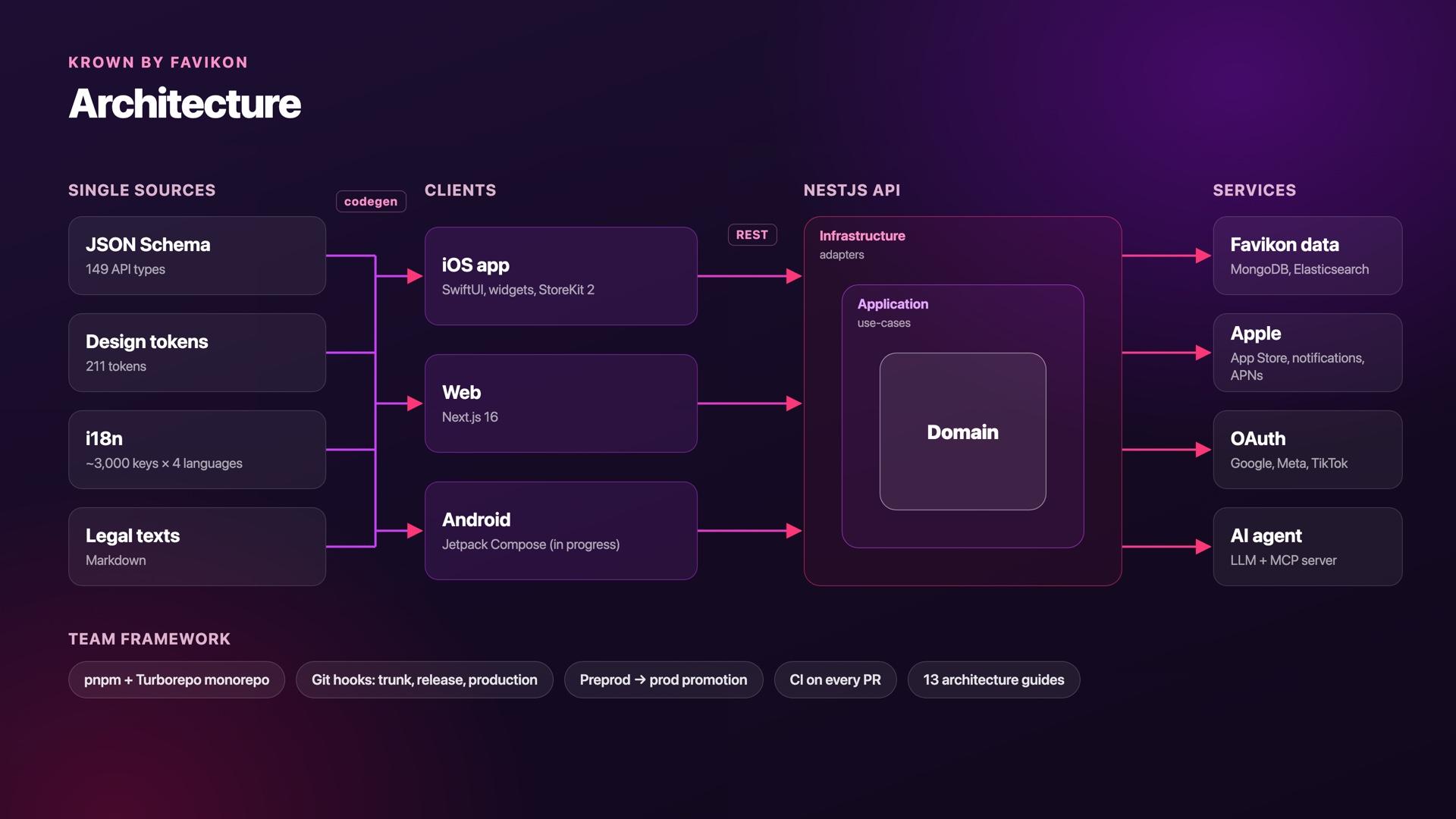
When I started the API for Krown, Favikon's B2C iOS app, the repo was empty and the list of external dependencies was already long: a MongoDB database shared with the Favikon platform, a search engine, Apple's servers for subscriptions, OAuth providers, push notifications and, later, a language model.A service that talks directly to all of that quickly becomes untestable: every test starts a database, mocks an SDK or waits on the network. So I set up a hexagonal architecture (ports and adapters) before writing the first feature. Six months later, the API has 34 modules, and that decision is the one that paid off the most.
One module, four layers
Every module follows exactly the same split:
modules/<module>/
├── domain/          # entities and value objects, no framework
├── application/
│   ├── ports/       # interfaces to the outside world
│   └── use-cases/   # application logic, knows only the ports
├── infrastructure/  # adapters: data, search, payments, LLM
└── presentation/    # REST controllers and DTOs
The rule fits in one sentence: dependencies point toward the domain. The domain imports nothing from the outside. Use cases only know the domain and interfaces (the ports). The infrastructure implements those interfaces, and the presentation layer calls the use cases.
The port is an interface, the adapter is a detail
A simplified example. The use case needs to read a score and notify analytics. It doesn't know where the score lives, or which analytics tool we use:
Switching databases or providers means writing a new adapter and changing one wiring line. The use case doesn't move.
The trade-off I accept: NestJS in the use cases
A "pure" hexagonal setup would have use cases import no framework at all. Here, they use NestJS's @Injectable and @Inject. That's a choice: dependency injection is exactly what hexagonal needs to plug in the adapters, and rewriting it by hand brings nothing.The line I hold is elsewhere: the domain imports neither NestJS, nor the ORM, nor the search engine. Its 199 files depend on nothing. And no use case imports Mongoose or the search engine client directly: everything goes through a port.
The real benefit: tests without infrastructure
Since use cases only know interfaces, I test them with in-memory fakes instead of real databases:
class FakeScoreRepository implements ScoreRepository {
  private rows = new Map<string, DailyScore>();
  seed(score: DailyScore) { this.rows.set(score.creatorId, score); }
  async findLatest(id: string) { return this.rows.get(id) ?? null; }
}

it("throws when the creator has no score yet", async () => {
  const useCase = new GetDailyScore(new FakeScoreRepository(), new FakeAnalytics());
  await expect(useCase.execute("c1")).rejects.toThrow(ScoreNotFound);
});
On the Krown API, 227 of the 234 use-case test files run this way, on 188 fakes, with no database and no network. The tests are fast and deterministic, and they test the business logic, not a container's configuration. Adapters are tested separately, on the translation between the domain and the technology.The fakes also become documentation: to understand what a use case expects from the outside world, you just read the ports it receives.
Two input adapters, one logic
Hexagonal isn't only about the output side. On the input side, the REST controllers are one adapter among others. When I built Koach, the app's AI agent, its tools went through an MCP server (Model Context Protocol): a second input adapter that calls the same use cases as the controllers.
So the agent doesn't have its own copy of the business logic: when a calculation rule changes, the app and the agent change together. Adding an interface (a command, a message queue, another agent) follows the same path.
What it takes to hold up in a team
An architecture doesn't survive four developers if it only lives in the head of the person who set it up. Three things helped:
An identical split across the 34 modules: you know where to look without asking.
A written architecture guide from the first commit, with the layer rule and examples, for the team as well as for their coding agents.
Rules checked by tools rather than by code review: for example, a pre-commit hook rejects a business enum that has drifted from the schemas shared with the apps.
Key takeaways
Set up hexagonal before the first feature: migrating to it later is expensive.
Keep the domain pure. A bit of framework in the use cases for injection is a reasonable trade-off.
The gain shows up in the tests: use cases tested on in-memory fakes.
Input adapters matter as much as output adapters: an AI agent can reuse your use cases instead of duplicating them.
This is also the subject of the first machine on Nightprint, which shows in 3D what breaks when you import Postgres into the core.