September 12, 2025
Overview
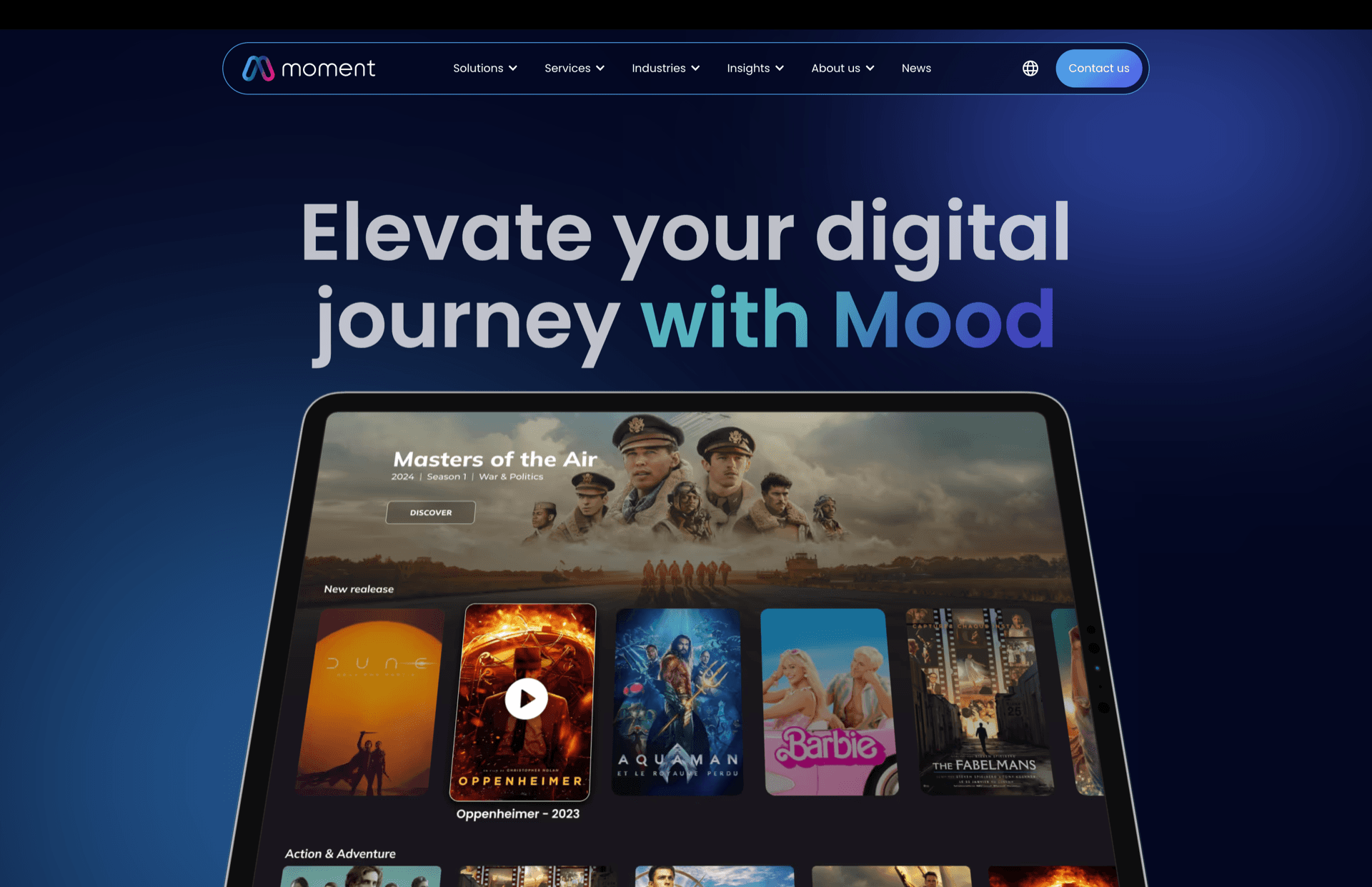
- Mood: an entertainment platform used on trains (Ouigo, TGV Lyria)
- Colombo: an internal tool for integrating music content
Mood project
Contributions
- Frontend development with Next.js and TypeScript
- Implementation of specific client requests (per-operator customization)
- Contribution to the Design System to improve interface consistency
- Creation of reusable modular components
- Collaboration with the design team through Zeplin
The Design System in practice
- Reusability: the same component is used across several screens and contexts, which avoids code duplication.
- Maintainability: a fix or an evolution applied to the component propagates everywhere it is used.
- Consistency: interfaces automatically follow the same visual rules, which strengthens the quality perceived by passengers.
Result
Colombo / Universal Music France project
Contributions
- Development of a robust API client with TypeSpec (strongly-typed SDK)
- Integration into the existing NestJS backend
- Implementation of a complete flow: ZIP retrieval → playlist extraction → CMS integration
- Resolution of the challenges tied to the complexity of the Universal Music API
TypeSpec and the typed API client
- Type safety: the data structures exchanged with the Universal Music API are checked at compile time, not at runtime.
- Fewer integration errors: field or format inconsistencies are detected early, which limits production bugs.
- Maintainability: a change in the contract is automatically reflected in the generated code, which reduces technical debt.
Music content integration pipeline
- Retrieval of the ZIP archives containing the music content provided by Universal Music France.
- Extraction and parsing of the data: opening the archives, reading the playlists and the associated metadata.
- Mapping of the extracted information to the model expected by the CMS.
- Integration into the platform so that the content is usable on the Mood side.
Result
Architecture & monorepo
- Library sharing: the Design System components and the common utilities are shared across applications, which avoids duplication.
- Codebase consistency: a single set of conventions and tools applies to the entire project.
- Centralized tooling: Nx makes it easier to manage internal dependencies and run tasks selectively.
Tech stack
- Frontend: Next.js, React, TypeScript, Design System, Zeplin
- Backend: NestJS, TypeSpec
- Tools: Nx (monorepo), GitHub, Docker, Jira, Confluence
Challenges and lessons learned
- Adapting a platform to very specific client needs while keeping a generic base
- Quickly integrating a complex API (UMF) into an existing project
- Working in a monorepo environment with library sharing
- Improving my technical communication (Jira tickets, documentation)
Impact
- Mood features in production on Ouigo and TGV Lyria trains
- Automation of the Universal Music France integration
- Modular components contributing to the longevity of the Design System
What this internship gave me
- Consolidation of skills in full stack development (Next.js, NestJS)
- Experience in API design and the generation of typed clients
- Collaborative work in a multidisciplinary agile environment
- Autonomy, adaptability, and effective communication