October 11, 2026
Overview
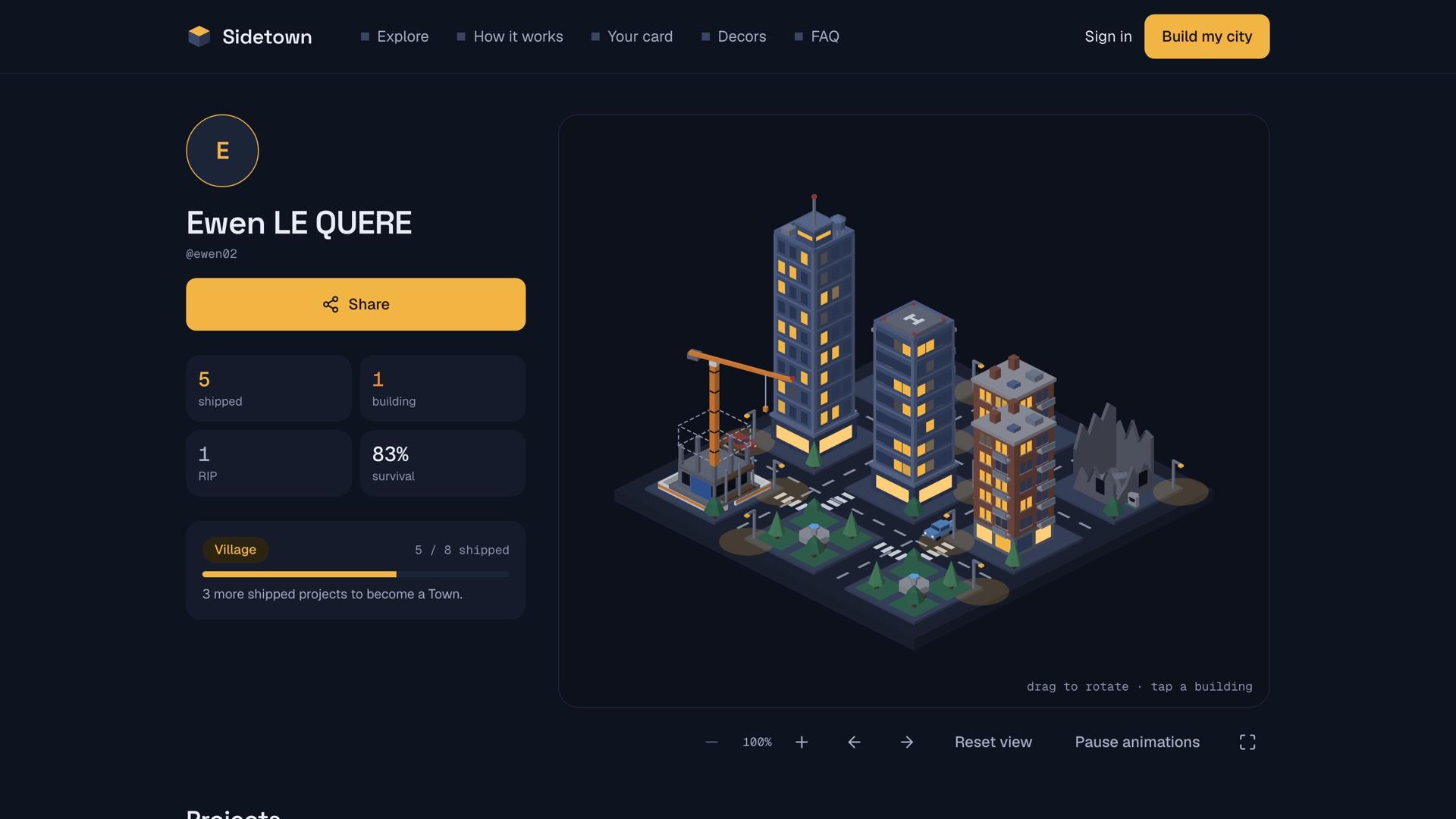
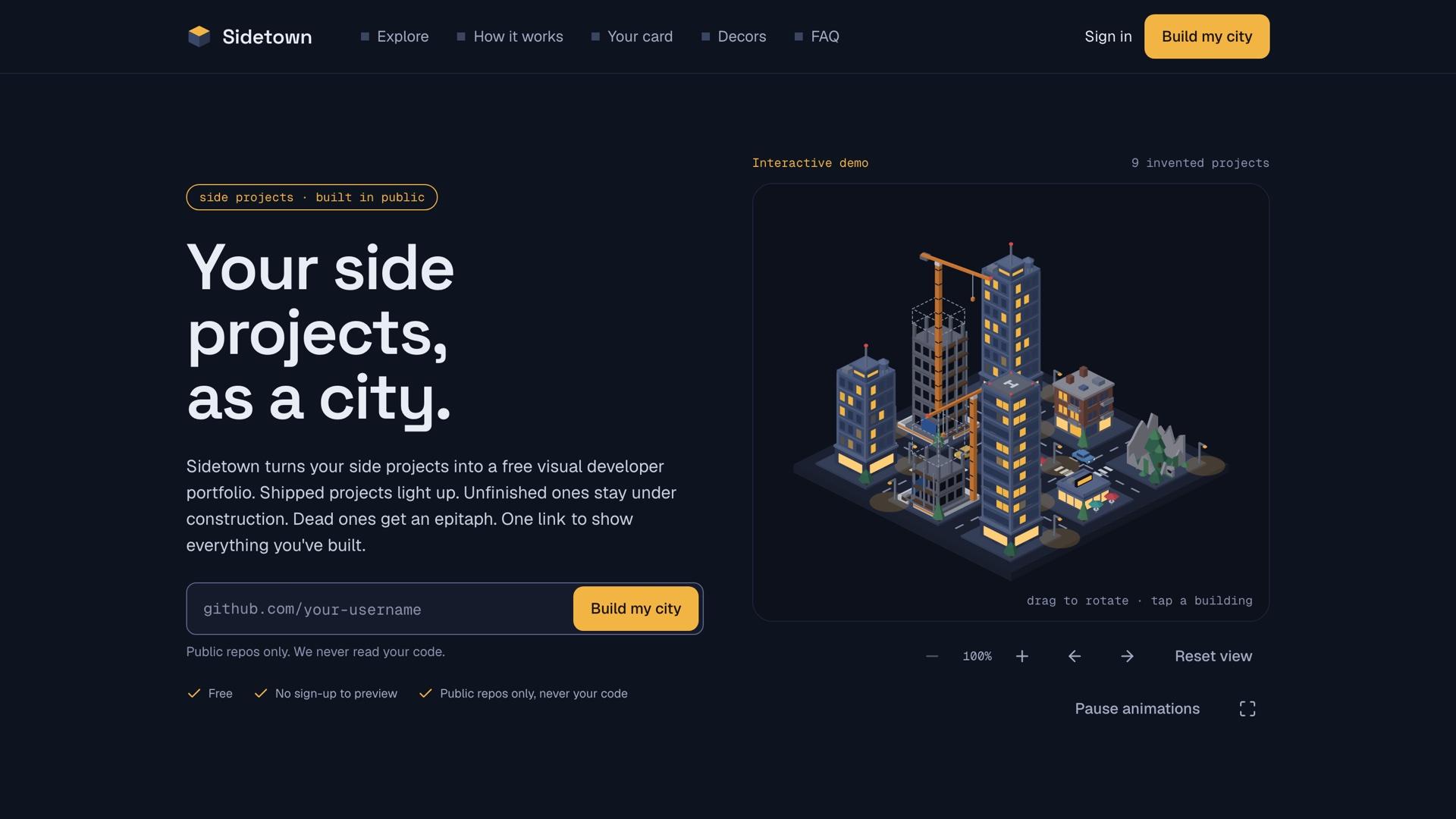
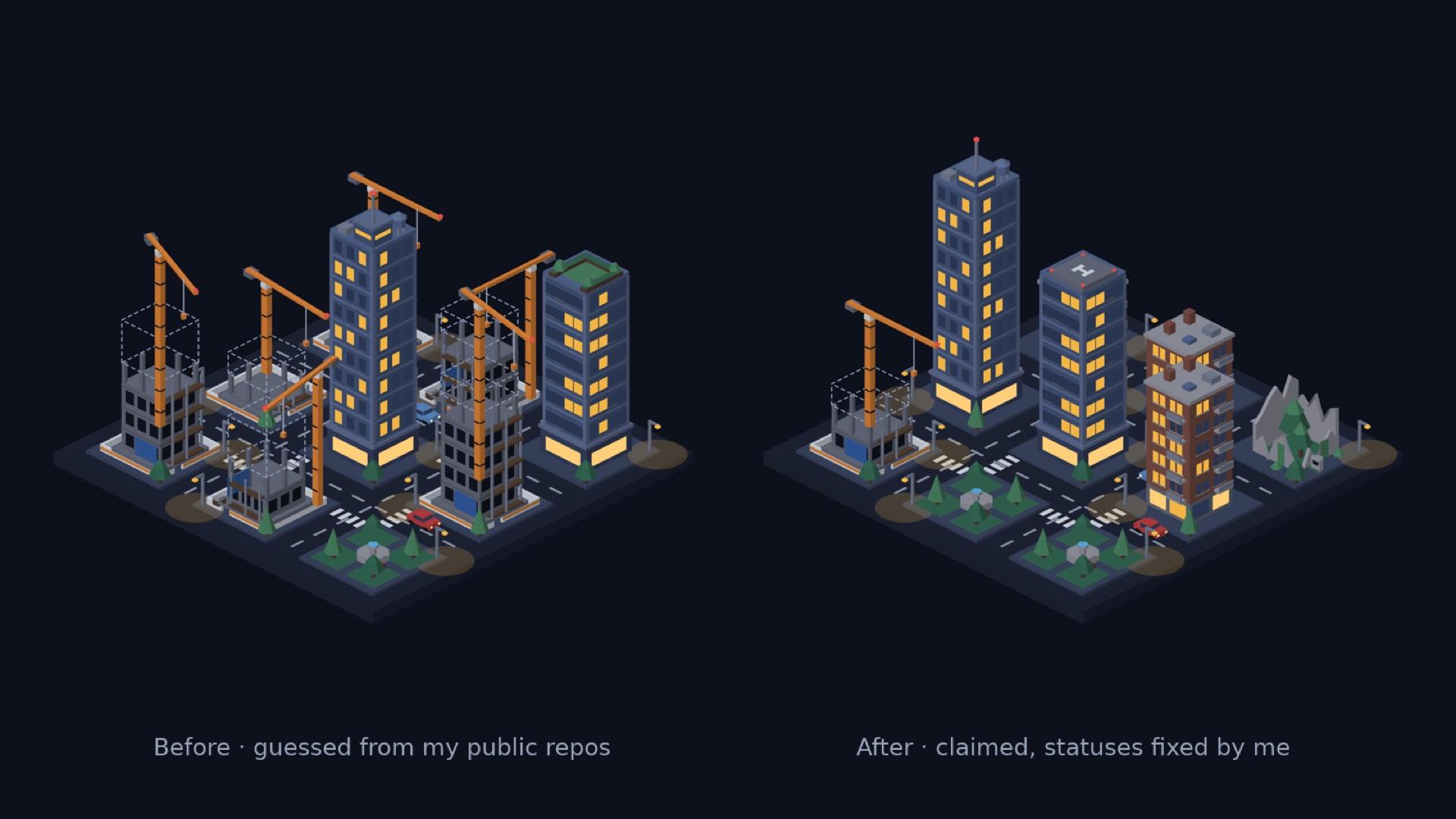
- Shipped projects become lit buildings
- In-progress projects are construction sites with a crane: the more hours spent, the taller the building
- Abandoned projects become ruins with an epitaph
Key features
Public city
- Orbit camera, zoom from 1× to 3×, immersive view, pause animations
- Living city: cars, swinging cranes, flickering windows, a Mars rocket launching every 40 seconds
- Project panel and a static page for each building
- Accessibility: every building is a keyboard-accessible button, with touch targets widened to 44 px
GitHub import
- Public preview at
/preview/<login>: buildings grow one after another, nothing is stored - Review screen: proposed status, "Still alive?" badge, epitaph, hide
- Detection of projects already added by hand
Share kit
- Card (1200×630) and story (1080×1920) generated on the server
- "Moment" cards when a project ships or dies
- README badge, post text in 3 tones, sharing to X, LinkedIn and the phone's share sheet
- 12-second timelapse MP4, encoded in the browser
Dashboard & Pro offer
- Live editor: a logarithmic hours slider (from 1 h to 3,000 h) grows the building in place
/exploregallery of published cities- Pro "Mars base" decor, purely cosmetic, as a one-time payment through Stripe Checkout
- GDPR JSON export and immediate account deletion
Architecture
An in-house 3D engine with zero dependencies
Postgres (Neon)
   └─▶ CityInput ─▶ renderCity() ─▶ SVG
          ├─▶ page: inline SVG in ISR HTML
          ├─▶ browser: editor, camera, animations
          ├─▶ sharing: resvg ─▶ PNG versioned by sha256
          └─▶ video: canvas ─▶ WebCodecs ─▶ MP4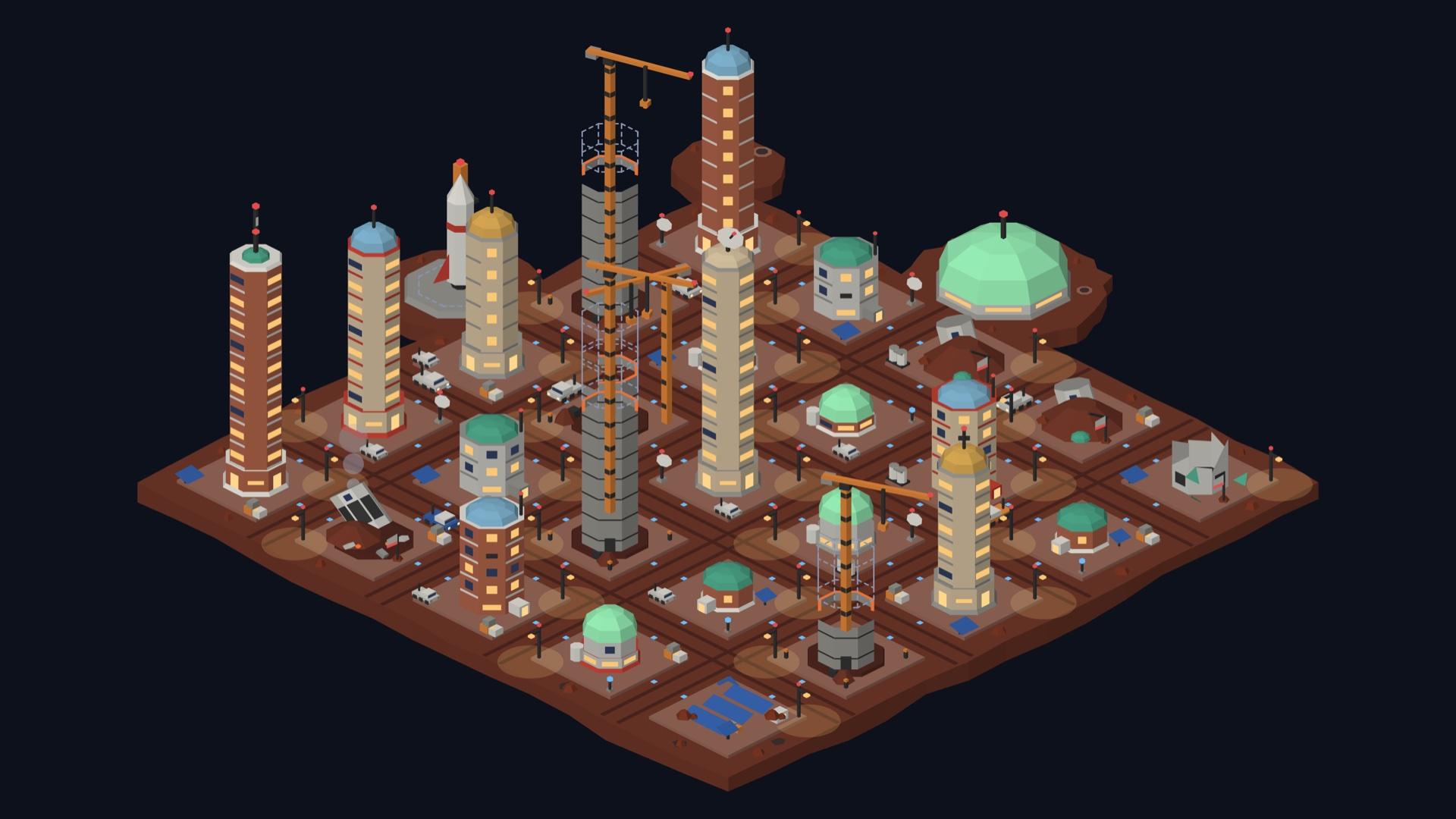
Folder layout
src/
├── app/          # Routes: city, explore, dashboard, api
├── engine/       # Pure 3D → SVG renderer
├── video/        # Timelapse → MP4 encoder
├── github/       # Repos, status guessing
├── db/           # Drizzle schema and queries
├── lib/          # env, auth, rate limit, analytics
└── components/   # Atomic design + motion hooks
kit/              # City and Mars decors (Python)
design/           # Tokens, specs, 54 mockups
Data model
user, session, account, verification), then city, project, entitlement and github_preview_cache. IDs are UUID v7, business rules are mirrored as CHECK constraints, and every user table cascades on deletion: the GDPR deletion is a single statement.
Key decisions
- Fixed lots in square rings: adding a project never moves existing buildings. This is what made the timelapse possible.
- Image URLs versioned by the SVG fingerprint: served as
immutable, no cache ever needs purging. - Pro is granted only by the Stripe webhook (idempotent), and the decor is recomputed on every read: a refund reverts it automatically.
- An archived repo is proposed as RIP, an inactive one only gets "Still alive?": the owner always decides.
- Schema-driven GDPR tests: every table with a
user_idmust appear in the export and be emptied on deletion.
Tech stack
Frontend
- Framework: Next.js 16 (App Router, Server Actions, ISR,
unstable_cache), React 19, strict TypeScript - UI: Tailwind CSS 4, atomic design system
- Rendering: in-house 3D → SVG engine, resvg (PNG), WebCodecs + mediabunny (MP4)
- Validation: zod 4
Backend
- Database: PostgreSQL (Neon) + Drizzle ORM
- Auth: Better Auth (GitHub OAuth, no token stored)
- GitHub: Octokit
- Payments: Stripe (Checkout, signed webhook, coupon, refunds)
- Analytics: PostHog EU, server-side only, cookieless
Quality & DevOps
- Tests: Vitest, close to 500 cases including tests against a real Postgres database, SVG snapshots of the engine
- CI/CD: GitHub Actions. Lint, typecheck, tests and build, then a Docker image (GHCR), Drizzle migration, SSH deploy and external smoke tests.
- Hosting: OVH VPS, Docker Compose behind Caddy, hardened container (read-only,
cap_drop ALL, non-root, 512 MB and 1 CPU) - Tooling: pnpm, Biome, Playwright (Chromium + WebKit audits from 320 px to desktop), Lighthouse mobile 95–98
- Coding agents: Claude Code, Cursor and Codex through a shared
AGENTS.md, custom skills and MCP servers (Neon, Playwright, Blender)
Challenges and learnings
- Node in 512 MB: Node 24 sizes its heap from the container limit. The young generation shrank to 2 MB and rendering spent its time in garbage collection (3.4× slower).
--max-semi-space-size=16took a render loop from 1,330 ms to 364 ms, and--v8-pool-size=1the gallery from 1.1 s to 0.73 s. - An erratic gallery caused by Neon cold starts:
unstable_cacheand tag invalidation brought the time to first byte (up to 2.7 s) down to 9–24 ms, and CPU per request from ~700 ms to ~10 ms. Details in the article Next.js in a 512 MB container. - An SVG sent twice, in the HTML and in the RSC payload: the gallery document went from 2.53 MB to 1.22 MB, and the RSC payload from 1.39 MB to 78 KB.
- A security bug caught by a test: a raw SQL query unlocked Mars for every city. It was rewritten with Drizzle's query builder, and the test now includes another user's purchase.
- A refund tested in production: ISR kept Mars on screen for 3 minutes after the refund. The webhook now revalidates the city.
- Safari: a 1 px hydration mismatch caused by
Math.hypot,navigator.sharerefused after anawait, clicks lost when an animated SVG face was replaced. - Privacy by design: no OAuth token, IP or user agent stored, cookieless server-side analytics.
By the numbers
- 182 commits in 11 days, 2 releases
- ~23,500 lines of TypeScript and ~1,900 lines of procedural Python
- ~500 tests across 76 files
- 64 documented architecture decisions
- Timelapse: 15.5 ms per frame in Chromium for a 12-project city
- Lighthouse mobile: 95 to 98
Current status