April 9, 2026
Overview
Key features
RAG pipeline
- Multi-format parsing: PDF, DOCX, TXT, Markdown, CSV, HTML
- Parent-child chunking (150-token children, 512-token parents, tiktoken)
- Embeddings: OpenAI
text-embedding-3-small(1536d, optimized with Matryoshka 512d) - Vector Store: Qdrant Cloud (HNSW, cosine similarity)
- Hybrid reranking: 60% semantic + 40% BM25 lexical
- Redis embedding cache with a 7-day TTL
Real-time AI chat
- Token-by-token SSE streaming via Server-Sent Events
- Multi-turn conversations with history (last 6 messages)
- Source citations with a confidence score (HIGH / MEDIUM / LOW)
- User feedback (thumbs up/down)
- Configurable LLM (OpenAI
gpt-4o-miniby default)
Embeddable widget
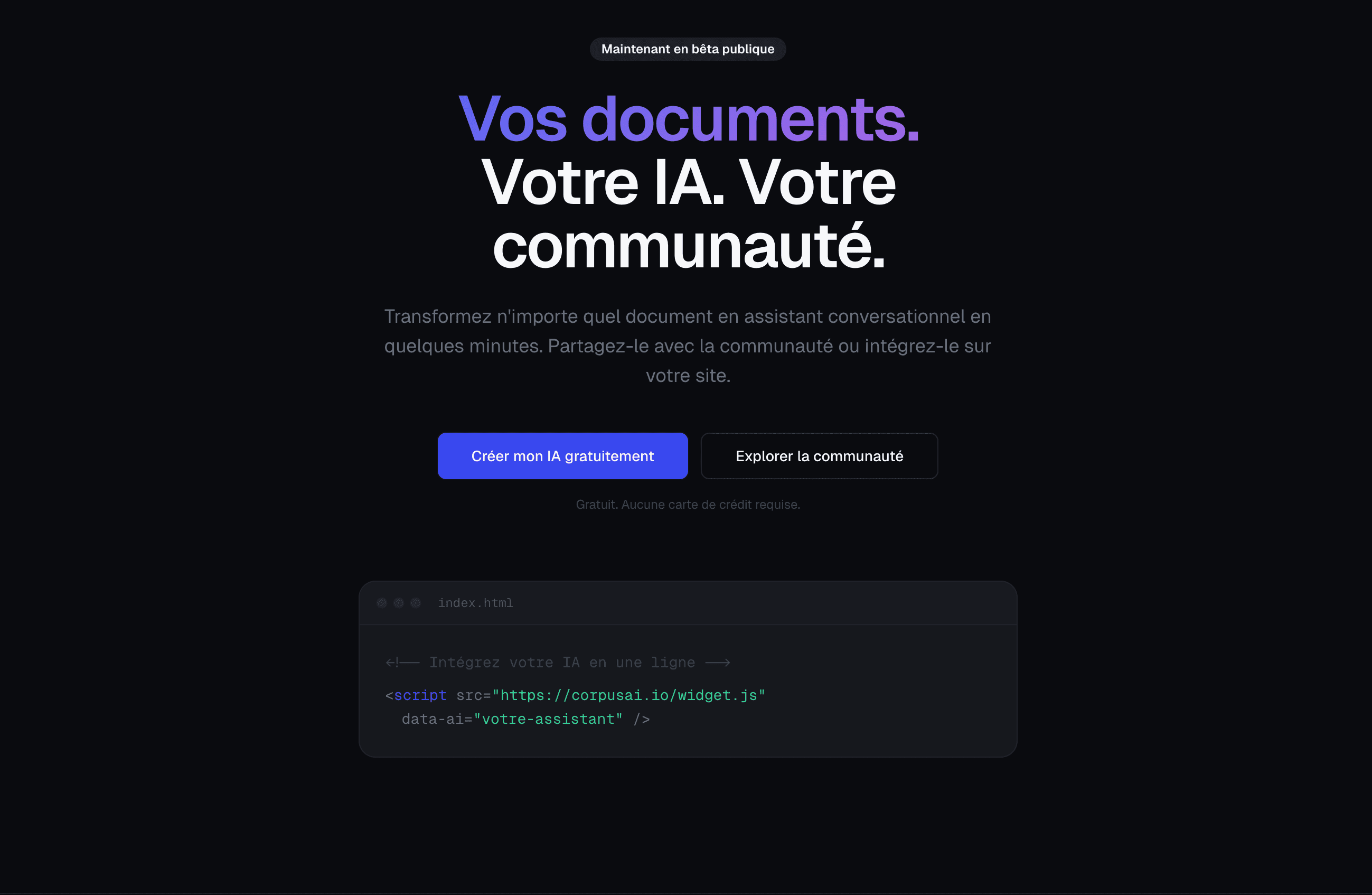
- Chat embeddable via iframe or script
- Customizable: theme (light/dark), colors, header/footer, dimensions
- 4 access modes: public, secret token, access code, invitation
- End-user portal with magic link authentication and persistent history
Extras
- Stripe billing: 4 plans (FREE → ENTERPRISE), webhooks, customer portal
- Public REST API + official TypeScript SDK (zero dependencies)
- Full FR/EN i18n (400+ keys, next-intl)
- Guided onboarding in 7 steps with 7 AI templates
- Analytics: global dashboard + per-AI (conversations, questions, tokens)
- 381 tests: 127 corpus, 140 API, 50 frontend, 24 E2E (Playwright)
Monorepo architecture
corpusai/
├── apps/
│   ├── web/          # Next.js 15 — dashboard + widget + landing
│   ├── api/          # NestJS 11 — REST API (15+ modules)
│   └── ai-worker/    # BullMQ — async document processing
├── packages/
│   ├── corpus/       # Complete RAG pipeline (127 tests)
│   ├── database/     # Prisma 6 + PostgreSQL (14 models)
│   ├── ui/           # 40+ components (Atomic Design)
│   ├── types/        # Shared types & enums
│   ├── subscription/ # Plans & limits logic
│   ├── ai-rules/     # System prompts & rules
│   ├── queue/        # BullMQ config & job types
│   └── sdk/          # Public TypeScript SDK
└── tooling/
    └── typescript-config/
Tech stack
Frontend
- Framework: Next.js 15, React 19, TypeScript strict
- State: React Query (TanStack v5)
- UI: Tailwind CSS, Radix UI, custom components (Atomic Design)
- Auth: Better Auth (OAuth Google/GitHub, 2FA)
- Real-time: SSE (streaming chat + document progress)
- i18n: next-intl (FR/EN)
- Monitoring: Sentry, PostHog, Vercel Analytics
Backend
- Framework: NestJS 11 (15+ modules)
- Database: PostgreSQL (Neon) + Prisma 6
- Cache/Queue: Redis + BullMQ (concurrency 3)
- Vector DB: Qdrant Cloud
- Email: Resend (magic links, invitations)
- Payments: Stripe (checkout, webhooks, customer portal)
- Security: Helmet, CORS, rate limiting, SSRF protection
- API Docs: Swagger/OpenAPI
AI / RAG
- Embeddings: OpenAI
text-embedding-3-small - LLM: OpenAI
gpt-4o-mini(configurable) - Vector Store: Qdrant (HNSW, cosine)
- Reranking: Hybrid semantic + BM25
- Chunking: Parent-child with tiktoken
- Streaming: token-by-token SSE
DevOps
- Monorepo: Turborepo + pnpm
- Containers: Docker multi-stage (3 services)
- Deploy: Railway (API + Worker + DB + Redis) + Qdrant Cloud
Challenges and lessons learned
- Designing a production-ready RAG pipeline (parsing → chunking → embedding → reranking → generation) with confidence scoring
- Implementing end-to-end SSE streaming (worker → API → frontend) for chat and document progress
- Architecting a flexible controlled-access system (4 modes) with magic link authentication for end-users
- Handling asynchronous document processing with BullMQ, real-time progress, and automatic retries
- Building a scalable monorepo with 8 shared packages and 3 applications
- Integrating a complete Stripe billing setup (4 plans, usage limits, webhooks, customer portal)
Impact
- Complete and tested RAG pipeline: 127 unit tests, hybrid reranking, confidence scoring
- End-to-end streaming: smooth "live typing"-style UX on AI responses
- Monorepo architecture of 8 packages + 3 apps, reusable and maintainable
- Feature-complete product with billing, public API, embeddable widget, and analytics